The kitchen trends dominating 2025 aren't chasing novelty. Here's what's actually worth doing in a Montgomery County home — and why.
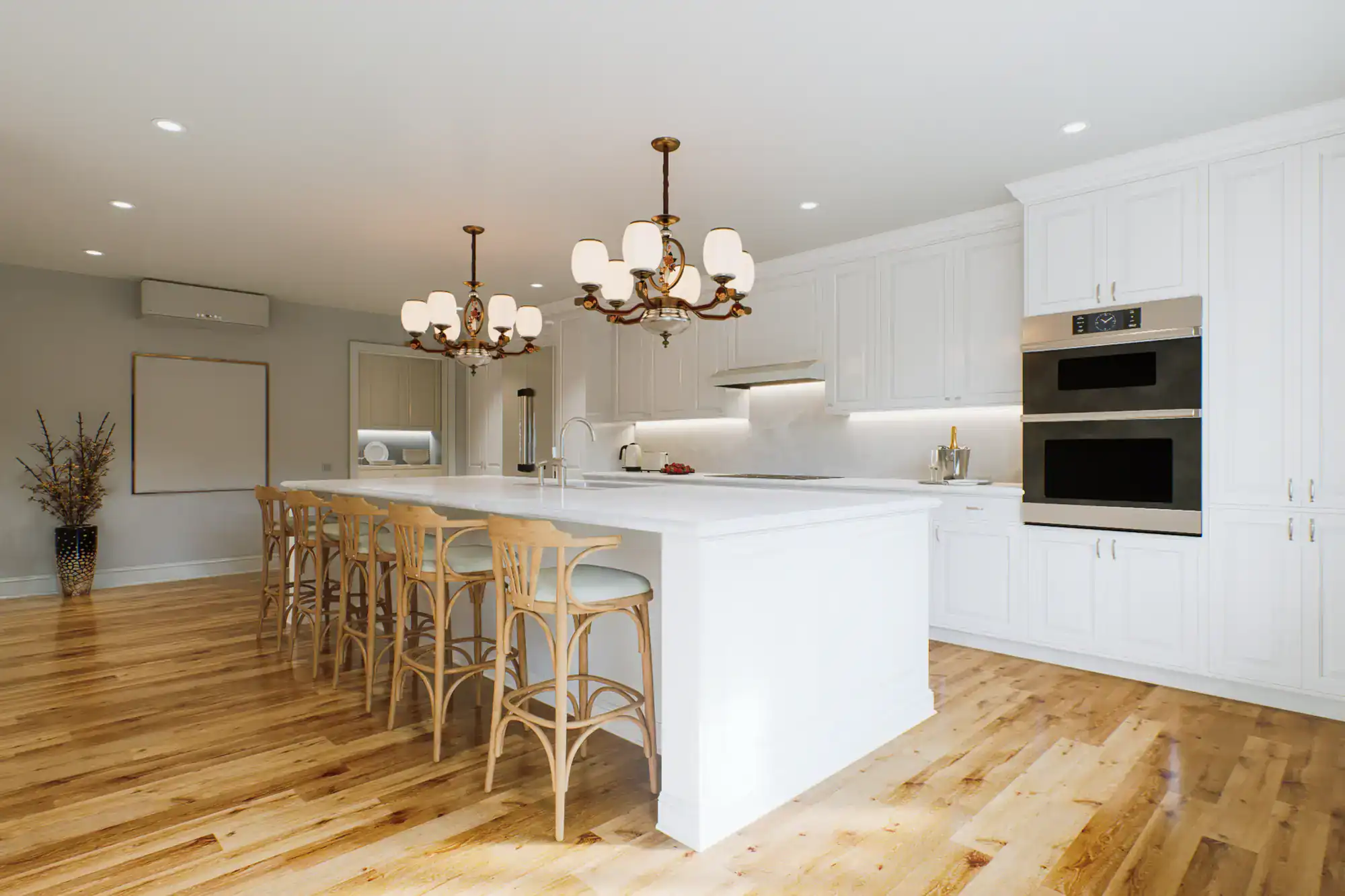
Most kitchen trend articles are written for an audience that’s casually browsing. But if you’re a Montgomery County homeowner — sitting in a kitchen that hasn’t been touched since the Clinton administration, or one that was “updated” in 2012 with gray everything — you’re probably not browsing. You’re trying to make a real decision about a significant investment. This post is written for you. We’ll walk through what’s actually shifting in kitchen design right now, what those shifts mean for the kinds of homes that exist in Bethesda, Potomac, Rockville, and Chevy Chase, and how to think about a remodel that won’t leave you with regrets.
The clearest signal from every major industry survey this year is that homeowners and designers are done with cold, clinical kitchens. The all-white kitchen — which ruled for the better part of a decade — is losing ground fast. In the most recent NKBA data, wood cabinets edged past white for the first time in nearly ten years, with 29% of homeowners choosing wood versus 28% for white. That’s not a dramatic gap, but the direction matters.
What’s replacing the cold-gray-and-white era is something warmer, more textured, and more personal. Warm neutrals, earthy tones, natural stone surfaces, zellige tile backsplashes, and transitional design that ages beautifully — that’s the consensus. A survey of industry professionals found that 72% name transitional, timeless design as the dominant style for the next three years. This isn’t a niche preference. It’s where the market has landed.
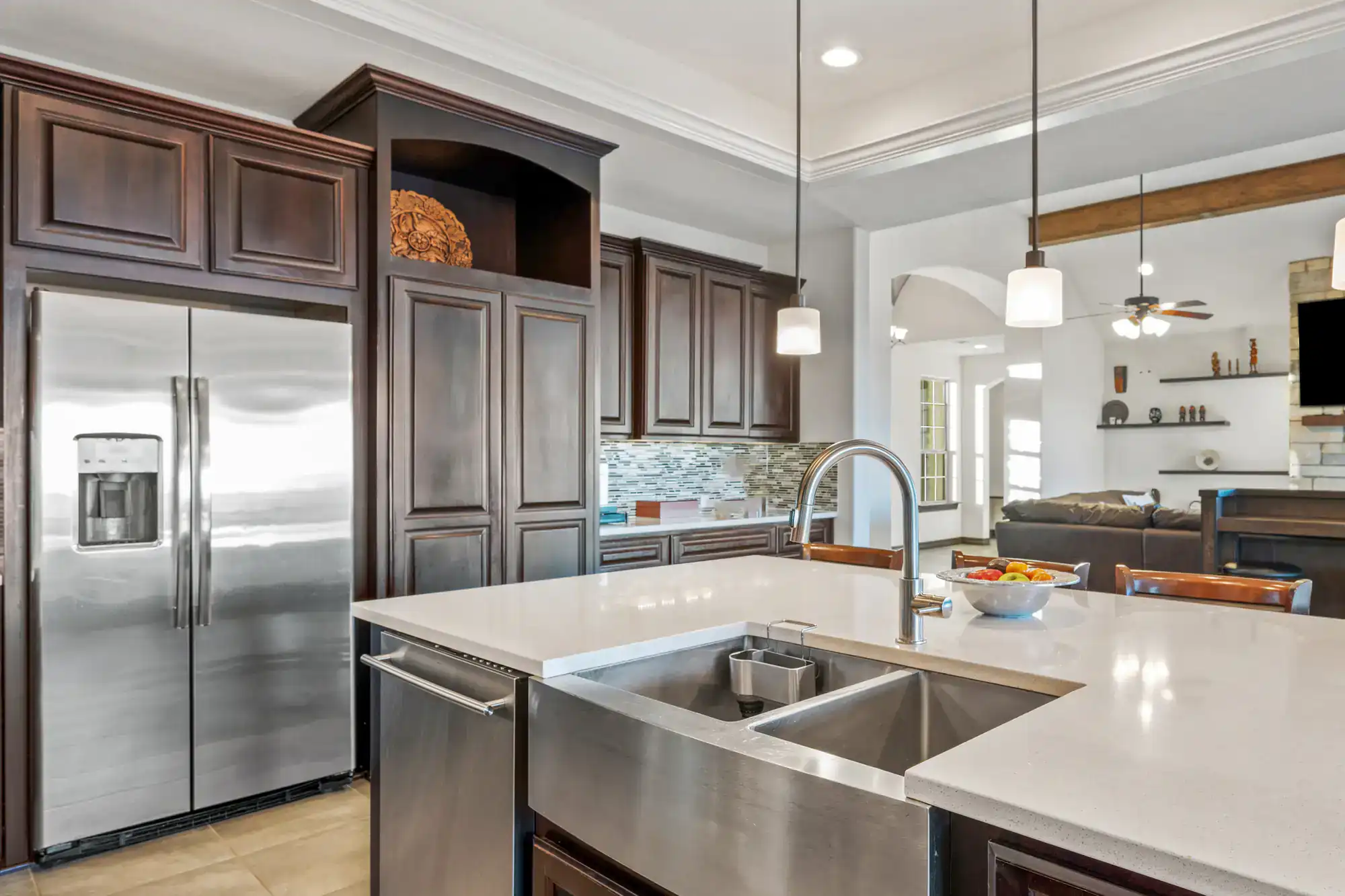
It’s worth being specific here, because “warm and timeless” can sound like marketing language if you don’t ground it in actual choices. What it looks like in practice is walnut or warm-toned wood cabinetry, quartz or natural stone countertops that serve as a visual focal point rather than just a work surface, textured backsplashes using handmade ceramic or zellige tile, and hardware in brushed brass or matte black that feels intentional rather than trendy.
Color is entering the kitchen in a real way — 71% of designers report that their clients are actively asking for kitchens that reflect their personality rather than defaulting to neutral safety. But the colors that are landing well aren’t bold for the sake of bold. Muted greens, warm earthy tones, soft creamy yellows, and deep oxblood or plum accents are showing up in ways that feel grounded and considered. These are colors that work with natural light, age gracefully, and don’t require a full renovation to update in ten years.
What’s quietly fading out: cold gray palettes, all-white cabinetry as the default choice, and the kind of extreme minimalism that prioritizes a showroom look over a livable one. Dark navy cabinets, which had a strong run, are being replaced by richer, more complex tones. None of this is happening overnight, but the direction is consistent across sources.
Texture is what makes a kitchen feel like it belongs to someone, rather than belonging to a showroom floor. A flat, smooth kitchen — even a beautifully designed one — reads differently than one where the backsplash has some dimension, the countertop has visible movement in the stone, and the cabinet faces have a subtle grain.
Not every trend is worth chasing, and part of making a smart remodel decision is knowing the difference between what photographs well and what actually improves how you live in your kitchen. A few things consistently deliver on both counts.
Kitchen islands have moved well past “nice to have” into genuine functional territory. When designed well — with integrated seating, adequate prep space, and thoughtful placement relative to traffic flow — an island changes how a kitchen works, not just how it looks. For the split-levels and Colonial Revivals that are common across Rockville, Kensington, and parts of Bethesda, MD, adding or expanding an island is often the single biggest quality-of-life upgrade a remodel can deliver.
Smart storage is another area where the investment pays off in daily use. Built-in organizers, multi-layer drawers, and pull-out systems aren’t glamorous, but they’re what people notice six months after a remodel when the kitchen is still functioning exactly the way they hoped. The clutter-free look that comes from genuinely well-designed storage is different from the clutter-free look that comes from hiding everything in a pantry and hoping for the best.
Open shelving is still popular, but the version that’s holding up is the lived-in, personal kind — books, plants, a few colorful pieces — not the perfectly curated Instagram version that requires constant maintenance to look right. If you’re considering open shelving, think about whether you want to maintain it or whether closed cabinetry with good hardware will serve you better.
The kitchens that hold up best are the ones where every choice was made for how the room actually gets used. Avoid anything that requires a specific ecosystem to maintain — smart appliances that only work with a proprietary app, or materials that are beautiful but require specialized cleaning and sealing — because those tend to add friction over time.
Want live answers?
Connect with a Optima Design Group expert for fast, friendly support.
Trend coverage is almost always written for a generic audience. But the homes in Montgomery County, MD have a specific character — a lot of them were built between the 1950s and 1970s, and they come with their own architectural logic. Colonials in Chevy Chase and Bethesda, split-levels in Kensington and Silver Spring, ramblers in Colesville and Four Corners — these aren’t interchangeable with newer construction, and a kitchen remodel that works well in one type of home doesn’t automatically translate to another.
The warm, timeless aesthetic that’s dominating right now is actually a particularly good fit for this housing stock. These homes were built with natural wood floors, brick fireplaces, and architectural details that always wanted warmth. The all-white kitchen trend of the 2010s was a mismatch for a lot of them — it worked against the character of the house rather than with it.

This is one of the most common questions we hear, and it’s worth answering clearly because the stakes are real. In Montgomery County, MD, permits are required for any kitchen work that involves structural changes, new or relocated plumbing, electrical alterations, or HVAC modifications. Cosmetic-only work — painting, swapping out tile in the same location, replacing a faucet — generally doesn’t require a permit. But the line between “cosmetic” and “permitted” is narrower than most homeowners expect.
The reason this matters beyond the obvious legal compliance issue is resale. Montgomery County has strict rules, and if structural or electrical work was done without a permit, it can create serious complications when you go to sell. Buyers and their inspectors will find it, and at that point your options are limited and expensive.
The Montgomery County Department of Permitting Services handles all building permits for kitchen remodels. For well-prepared applications, the Fast Track program can result in a permit in three to five days. Standard review is committed within 17 days. Plumbing-related work also requires WSSC review. None of this is particularly complicated if your contractor handles it as a matter of course — but it’s a real problem if they don’t, or if they suggest skipping it to save time.
In Maryland, only contractors who hold an active MHIC (Maryland Home Improvement Commission) license can pull permits on a homeowner’s behalf. This is a state-level requirement, not a suggestion. When you’re vetting contractors for a kitchen remodel in Montgomery County, MD, asking for their MHIC license number and verifying it at mhic.maryland.gov takes about two minutes and tells you a great deal about who you’re dealing with.
We’ve held MHIC license #28145 for decades. It’s not something we mention as a credential — it’s something we mention because it’s the minimum standard for doing this work legally in Maryland, and homeowners deserve to know that not everyone they’ll talk to meets it.
Cost is the question everyone has but not everyone asks directly, so let’s be straightforward about it. In Maryland, a minor kitchen update — new cabinet paint or refacing, updated hardware, a countertop swap, a new backsplash — typically runs in the $27,000–$45,000 range. A mid-range remodel with new cabinetry, quartz countertops, and updated appliances runs $35,000–$80,000. A full remodel in a higher-value market like Bethesda or Potomac, MD, where the homes are larger and the finishes are higher, can run $75,000–$200,000 depending on scope.
Those numbers have shifted significantly in recent years. An analysis of over 4,300 kitchen permits issued in Montgomery County, MD between 2000 and early 2026 found that the average kitchen project value went from $56,376 in 2019 to $240,661 at its 2024 peak — a 327% increase. Values moderated to $167,589 in 2025, but they remain nearly three times pre-pandemic levels. This reflects both rising material and labor costs and the fact that Montgomery County homeowners are investing more seriously in their kitchens than they were five years ago.
On the return side, the data is consistently encouraging for kitchens specifically. A minor kitchen remodel delivers a 96–113% ROI depending on the study and year — meaning homeowners recoup as much as they spend, or more. Major upscale remodels return closer to 36–50%. The gap between those two figures is worth understanding: the kitchen improvements that return the most value are usually the ones that refresh and elevate what’s there, not the ones that gut everything and start over. That’s useful information if you’re trying to decide how far to take a project.
It’s also worth noting that 54% of real estate professionals recommend upgrading the kitchen before listing a home for sale. In a market like Montgomery County, MD — where home values in Bethesda and Potomac regularly exceed $1 million — a well-executed kitchen remodel is both a quality-of-life investment and a financially defensible one.
The trends are useful context, but they don’t build anything. What actually determines whether a kitchen remodel goes well is who does the work — and how they do it. In a market with as many contractors as the DMV, the challenge isn’t finding options. It’s knowing which ones are worth trusting with your home.
A few things worth verifying before you hire anyone: their MHIC license number, their liability insurance, whether the owner is personally involved in the project or whether you’ll be handed off to a crew you’ve never met, and what their reviews actually say — not just the star rating, but the specific details. Do reviewers mention that the final bill matched the estimate? That the crew showed up every day? Those specifics matter more than a five-star average.
We’ve been doing this work in Montgomery County, MD since 1973. The warm, timeless kitchen aesthetic that’s dominating right now isn’t new to us — it’s what the homes in Bethesda, Rockville, Chevy Chase, and Kensington were always built for. If you’re ready to talk through what a kitchen remodel might look like for your home, reach out to Optima Design Group. We’re happy to take a look and give you a real answer.
Summary:
Article details:
Share: